

Many safari stays are decided before a traveler ever visits a property’s website: inside a tour operator’s itinerary builder, a trade directory, or an AI assistant’s shortlist. The properties that get picked are the ones whose rates, availability, and content are current and easy to package at that moment.
That’s why discoverability and distribution are the new occupancy driver, for property owners first, and for the operators who sell them too.
Your Lodge Isn't Booked on Your Website. It's Booked in Rooms You're Not In.
A traveler in Amsterdam decides, on a Tuesday night, that next year is the year. The Serengeti. The Okavango. A honeymoon they’ve dreamed about for a decade.
They don’t open ten browser tabs anymore. They open one chat window first: “Plan me a two-week safari in Tanzania and Botswana, mid-range to luxury, August, good for a couple.”
From there their journey starts. In that moment, a handful of lodges and camps are surfacing as part of a tour being marketed, or quietly being skipped. And here’s the part most property owners haven’t fully absorbed: that first cut is happening in rooms they’re not standing in. Not on their website. Not on the traditional hotel booking platform. Not on their Instagram. In an operator’s itinerary builder, in a directory being searched, in an AI assembling a shortlist of tours in seconds.
If you own a property, your occupancy is increasingly shaped upstream, before a guest ever sees your beautiful photos.
The question that defines your next decade isn't "Is my camp special?"
It's "Am I present, current, and selectable in the channels where the trip actually gets built?"
The Demand Has Never Been Better, and That's the Trap.
First, the good news. Safari travel was worth roughly $37.3 billion in 2025 and is projected to reach around $60.7 billion by 2035. Travelers are staying longer, going deeper, and paying more for slow, immersive, sustainable experiences.
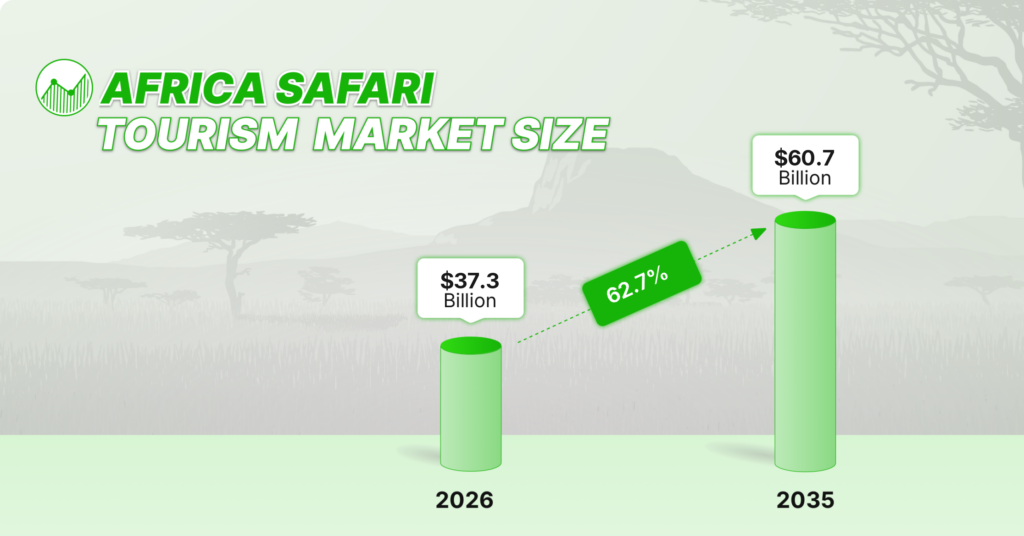
Africa Safari Tourism Market Size, Source: Future Market Insights Inc.
But look closer, and you’ll see the squeeze. New lodges and camps are opening across Botswana, Kenya, Tanzania, and South Africa at a pace. Supply is rising. And “slow travel”, the defining trend of the moment, means travelers are choosing fewer properties per trip and staying longer in each. More properties, fewer slots per itinerary. The competition to be the lodge that makes the final cut has never been more intense.
So demand isn't the problem. Selection is. And selection happens in the channels where tours are marketed and built, which means your distribution matters as much as your product.
Where Your Bookings Actually Originate.
For a (safari) property owner, occupancy flows through other people’s pipelines.
A traveler asks an AI assistant and gets a curated shortlist from platforms like SafariBookings, a local tour operator and some specialized agents. An overseas agent searches a directory for “Okavango, wildlife viewing deck, triple room” for a new 2028 package. An operator builds a two-week itinerary and needs to slot in three lodges, fast. In every one of those moments, your property is either in the flow, accurate, current, ready to be packaged, or it isn’t.
The most beautiful camp in Africa is invisible if its information doesn’t move cleanly through the channels where business flows. You can pour everything into your property and still lose the booking to a lodge that was simply easier to find, package, and trust at the exact moment the decision was made.
Why the Operators Pick the Property They Can Package.
Here’s where the operator side of the story matters, and why your fate and theirs are linked.
Research across the sector shows that 78% of travelers book with the first business that responds correctly to their inquiry. Harvard Business Review study of B2B companies’ online sales leads also shows that inquiries answered correctly within an hour convert roughly seven times better than those that wait a day. Agents and operators live under brutal speed pressure. When a dream inquiry lands at 9pm, the operator who turns it into a polished, personalized quote by breakfast wins it.
Now put yourself in that operator’s shoes, building the itinerary at 9pm. They reach for the properties whose rates are current, whose availability is clear, whose photos and descriptions are ready to drop in. The lodge with rates in an old file on a shared folder and details trapped in someone’s inbox doesn’t get “considered and rejected.” It simply doesn’t make it into the build because including it would slow the operator down at the exact moment speed wins.
So, for a property owner, being easy to distribute is a competitive advantage. And for the operator, rich, current, instantly packageable inventory is the difference between sending a quote tonight and losing the booking tomorrow. You need each other to move fast.
AI Might Be the New Front Door, but It's a Doorway, Not a Dealmaker.
Then comes the shift everyone’s talking about. Around 40% of travelers already use AI tools to plan trips, and roughly one in three trip-planning sessions now starts with an AI assistant rather than a search engine. You’ll hear bold predictions about fully agentic AI booking entire trips end-to-end. For a city break, maybe. For a two-week, five-figure safari across two countries? Not a chance, and that’s precisely the point.
Booking a safari is not booking a hotel room. It’s park fees and conservancy levies, the need for the right guide, transfers and charter flights, visas, driving conditions that change with the seasons, high-ticket lodge bookings and guided game drives, all stitched into one high-stakes, once-in-a-lifetime trip to a country the traveler has usually never set foot in. That is not a transaction. It’s a trust decision. And trust, in this industry, has a human face: the operator who actually knows the country, who has stood in that riverbed in the wet season and knows the road won’t hold.
No traveler is going to hand that to a chatbot. They will use AI to dream, to compare, to narrow, and then they will want a real human who understands the challenge to take the wheel.
The upstream flow and the marketing are changing. The trust at the end of it is not. It's still in very human hands.
AI Doesn't Replace Trust; It Hunts for It.
Here’s the part that should excite anyone serious about this industry, and worry anyone sitting still.
As AI assistants search for the best answer to “where should I stay in the Delta,” they don’t reward the loudest marketer. They gravitate to the most credible, structured, connected sources, the places where trustworthy information is concentrated and verifiable. AI is, in effect, a trust-seeking machine. It amplifies the operators and lodges that are easy to find, easy to verify, and clearly part of a credible network. The isolated, the stale, the unstructured simply fall out of the answer.
This is why a connected ecosystem changes the game. When the directory, the lodges, the operators, the itineraries, the reviews (of past clients) all sit in one searchable place, that place becomes a concentration of the industry’s trust, exactly what an AI is looking for, and exactly what a traveler is looking for. Being inside it means being surfaced and trusted. Being outside it means being invisible to the very channel travelers now start with.
That’s the uncomfortable, motivating truth for both lodges and operators: the trust of this industry is about to live in searchable places. You want to be in the room when the AI goes looking. The booking cycle (the quote, the reassurance, and the close) stays exactly where it belongs, with the humans who respond fast. AI just decides who gets the chance to have that conversation.
Why Connected Beats Beautiful.
So how does a single lodge, small chain or a mid-sized operator, compete? Not by working harder, or by dropping prices. By being connected.
This is the shift from scattered tools to a connected network. When your property’s profile, rates, availability, photos, and story live on one connected backbone, every channel pulls from the same current truth. Update a room once, and it’s correct everywhere, in the directory an agent searches, in the operator’s itinerary build, on the shared trip page a traveler forwards to their partner, in the data an AI assistant reads. Your content stops being something you re-send for every inquiry and becomes an asset that distributes itself while you sleep.
A disconnected property waits to be remembered. A connected one shows up automatically, everywhere business flows, and inside the trusted network.
The operators win the same way: connected inventory is instantly packageable, so they sell faster and lose fewer bookings. In a fragmented business, effort leaks at every handoff. In a connected one, effort multiplies.
The Decade Ahead Belongs to the Connected and Trusted.
Picture the lodge whose availability and story are always current, so when a traveler asks an AI for “a community-led camp in the Delta,” it’s in the answer, accurately, instantly. Picture that same property being the one operators reach for first, because dropping it into a quote takes seconds.
The travelers are already starting with AI. The operators are already under the clock. The trust still lives with the humans who know the country and understand their clients’ human need for peace of mind. The only open question is which lodges and which operators will be in the searchable, connected place where all of that comes together.
The boom is real. The bottleneck is distribution. The trust stays human. And the businesses that connect first will own the next decade of African safari.
See Where Your Property Currently Stands
Claim your free listing and check which fields are still empty.
No commitment. Manage every property from one account.
Frequently Asked Questions.
More and more of them start with an AI assistant, then turn to people. In a March 2026 YouGov survey for Expedia Group, 40% of travelers said they use or would use AI to help build itineraries, but 68% prefer to book with trusted travel brands. For a safari, that usually means a tour operator or specialist agent who builds the actual itinerary.
Often it isn’t a judgment on the property. Operators work under time pressure, so they reach for properties whose rates, availability, photos, and descriptions are current and ready to drop into a proposal. If that information is hard to find, the property simply doesn’t make it into the build.
For a complex, multi-country safari, travelers still want a human to make the final call. In an August 2026 survey of U.S. AI users, 77% said they’d still rely on a human to make final travel decisions when using AI to plan. AI helps travelers dream and narrow down options; operators close the trip.
It means your property’s profile, rooms, rates, photos, and story live in one up-to-date place that feeds the channels where itineraries are built, so you don’t have to re-send the same details for every inquiry.
SafariOffice for Accommodations lets you claim and manage your listing so it appears where 4,000+ safari specialists build, market, and sell safari tours every day.