

Safari lodges and camps get booked through the trade when a travel agent, tour operator, or DMC includes them in a client’s itinerary. The traveler usually asks a specialist for a tour, the specialist chooses the properties, checks availability with each one, and confirms the stay once the client pays. B2B distribution means selling your rooms through businesses that build and sell safaris, instead of relying only on direct bookings from travelers.
For many safari properties, this is where a large share of booking decisions are made. Here’s how the chain works, where your property gets chosen, and what makes it easier to pick.
Why B2B Distribution Matters for Safari Properties.
Most lodge marketing advice is about reaching travelers directly through your website, social media, and online travel agencies. These direct-to-traveler (B2C) channels matter. But a multi-stop safari is harder to plan, with flights, transfers, park fees, seasons, and several properties that need to fit together.
That’s why many travelers hand the planning to a specialist. When they do, the specialist decides which lodges and camps go into the plan. The traveler may never have heard of your property until it appears in their personalized proposal. This applies to international and regional travelers alike. Many domestic guests book through local agents and operators too.
If you’re only visible to travelers, you may be missing the place where many booking decisions are made. We explore this idea further in Where Safari Properties Get Chosen: Not Only Your Website.
Who Sells Your Property? The Trade Chain Explained.
The safari trade has several types of businesses. Their roles overlap, but here’s the general picture:
- Travel agents usually sell to travelers in their home market. Many rely on specialist operators to build the safari portion of a tour.
- Tour operators design and sell complete tours. They choose the properties, set the route, and price the itinerary. Some are based in the traveler’s home market, others in the safari destination itself.
- DMCs, inbound operators, and ground handlers are based in the destination. They handle tours for agents and operators abroad and often have close, practical knowledge of properties in their region.
- Representation companies promote a group of properties to operators and agents in specific markets.
- Wholesalers and bed banks package and resell rooms, often to travel agents.
A single tour might pass through more than one of these. For example, a traveler in London asks an agent, the agent works with a specialist operator, and the operator arranges the ground handling through a DMC in Arusha, Nairobi, Cape Town, or Maun. Other tours are simpler: a traveler books directly with a local operator in Kenya, Tanzania, South Africa, Botswana, Namibia, or elsewhere in the region. Either way, each business in the chain can influence whether your property is in the final itinerary. If any of these terms are new to you, our Safari Trade Glossary explains them in plain language.
How an Itinerary Gets Built, and Where Your Property Is Chosen.
Picture a consultant on a normal working day. They have a new inquiry for a tailored safari: 8 nights, mid-range budget, a family with two teenagers, traveling in July.
Here’s roughly what happens next:
- They draft the route. Which areas make sense for July, and how will the family move between them?
- They shortlist properties. They start with places they know and trust, then search for alternatives that fit the budget, the family, and the dates.
- They check the details. Room types that sleep four, child policies, activities for teenagers, and current rates.
- They check availability. By email, by phone, or through the property’s reservation system or agent portal.
- They build the proposal. Photos, descriptions, and a clear price go into a document the family can review.
Your property can be chosen or overlooked at steps 2 and 3. If you’re not on the shortlist, you’re not considered. If you’re on the shortlist but your details are unclear or out of date, the consultant may choose a property that’s easier to quote. Step 4 matters too. A safari specialist with a client waiting may book the first property that confirms availability.
What Do Tour Operators Need to Include Your Property?
When choosing accommodations for their itineraries, safari specialists need clear, accurate information they can use quickly. Make these easy to find:
- Exact location, including seasonal moves if you’re a mobile or migration camp.
- Room types, bed configurations, and maximum occupancy.
- Trade rates and terms: STO or net rates, child policies, deposits, and cancellation terms.
- What your rate includes: meal plan, activities, and whether park, concession, or conservancy fees and transfers are included.
- Photos and videos that look good in a client proposal.
- Services, amenities, activities, and facilities, so operators can match your property to what the client asked for.
- Practical information like access, airstrip, and transfer times.
- A responsive trade contact.
Margin matters too. One operator, writing in Tourism Update, argues that when lodges give small operators a much smaller commission than large partners (for example, 15% instead of 30%), those operators have little reason to sell the property. How you set trade terms is your decision, but it helps to know how operators see it.
How Can Your Property Be Present Where Itineraries Are Built?
Traditional trade marketing, like trade shows, sales trips, fam trips, and representation, builds relationships, and it still matters.
What it can’t always reach is the everyday moment of choice. Many itineraries are built at a desk, inside a tool, on an ordinary working day. If your property isn’t easy to find and quote right there, it’s easy to leave out, even when it’s the right fit.
That’s the gap SafariOffice was built for. SafariOffice is a sales, quote, and itinerary creation software used by safari tour operators and agents, with a separate B2B platform for accommodations. More than 4,000 safari specialists use it to build and send proposals, and accommodations keep their own listings up to date so the details specialists see are current.
A Basic Listing is free and lets your property appear in operator searches and proposals, with your photos and details. If you want more ways to support the specialists selling you, such as fact sheets one click away or a Co-branded Digital Page they can share with clients, see what a Premium Listing includes.
Where Does Your Property Information Go After an Operator Finds It?
In B2B distribution, your property details rarely stay in one place. Once a specialist includes you in an itinerary, your photos, room types, and descriptions are copied into a proposal, shared with the client, and often reused long after that first quote.
A typical path looks like this:
- Discovery: a specialist finds your property while searching for options that fit a client’s request.
- Quote: your property goes into an itinerary and a proposal the client reviews.
- Reuse: the itinerary is saved as a template or tour package and quoted again for future clients.
- Sharing: the proposal or a page about your property is forwarded to family members, sent by WhatsApp or email, or featured on the operator’s website and social channels.
- After booking: your property appears in the traveler’s tour documents and travel app.
- Wider discovery: published tours can also appear on consumer travel marketplaces, where travelers, and the AI tools they use, look for safari ideas.
Each step is another place your property is seen. It’s also another place where outdated details can spread. If an old rate, a room type you no longer offer, or last year’s photos get copied into a template, they can keep showing up in itineraries for months. Keeping one accurate source of your details means every copy further down the chain stays correct.
On SafariOffice, these steps are connected. The diagram below shows where a single listing is used across the platform and beyond it.
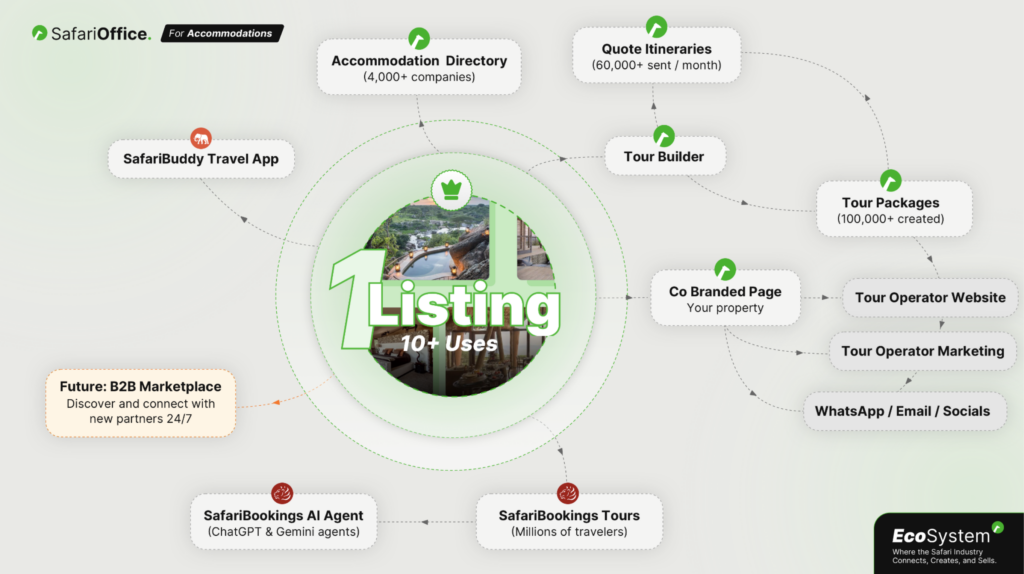
One listing, many uses: where your property details travel on SafariOffice.
How Do You Know If Your Trade Distribution Is Working?
You can’t improve what you can’t see. Useful questions to track include:
- How many operators are including your property in quotes?
- How many quotes become confirmed stays?
- Which new operators have discovered you recently?
- Which markets do your guests come from?
On SafariOffice, your listing’s insights show how often your property is used in tours, templates, proposals, and bookings, and by how many companies. The most detailed view is part of Extended Data Insights.
Get Your Property in Front of Specialists
Claim your listing for free and appear where operators and agents work daily.
No commitment. Manage every property from one account.
Frequently Asked Questions.
It’s selling your rooms through travel businesses, such as travel agents, tour operators, and DMCs, that include your property in the tours they build and sell to travelers.
Not necessarily. Many properties work directly with operators, while others use DMCs or representation companies to reach specific markets. The right mix depends on your size, your markets, and your team.
Keep everything an operator needs to sell your rooms in one up-to-date place. That means room types and occupancy, trade rates and terms, what the rate includes (meal plan, activities, and any park, concession, or conservancy fees), child policies, photos, and access and transfer details. Reply to availability requests quickly, too. A consultant with a client waiting may move on to another property if they can’t get an answer.
For most properties, direct and trade bookings work side by side rather than replacing each other. Many travelers ask a safari specialist to plan their tour, especially when it covers several stops, and the specialist chooses the properties. Working with operators helps you reach those guests, who may never find your website on their own. The right mix depends on your property, your markets, and your team.
Through trade shows, fam trips, recommendations, representation companies, and increasingly through searches inside the itinerary software they use to build proposals.
Yes. A Basic Listing is free and lets your property appear in operator searches on SafariOffice. A Premium Listing is a paid subscription with extra tools, and you can try it free for 14 days.